
Main points
- Researchers at Northwestern University have developed a method for converting methane into methanol using plasma, avoiding high temperatures and pressures.
- The technology allows methane to be converted into methanol, ethylene, hydrogen and propane, potentially reducing costs and making the process more environmentally friendly.
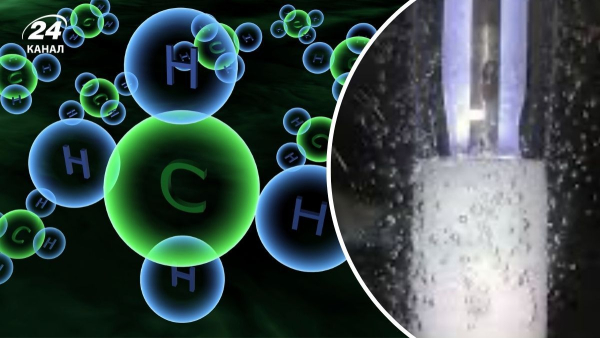
Scientists have turned greenhouse gas into useful fuel / Collage by Channel 24 / Photo by Depositphotos
Researchers at Northwestern University have developed a way to convert methane into methanol using plasma created by electrical pulses.
The technology bypasses the ultra-high temperatures and pressures typically required for such a process and could make clean fuel production cheaper and more environmentally friendly, writes Interesting Engineering.
Methanol has long been considered an important chemical for industry and energy. It is used as a fuel for cars, ships and stoves, as well as in the production of plastics, acids and as an industrial solvent. The main advantage of methanol is its clean, smokeless combustion .
However, traditional methanol production remains very expensive. Synthesis requires temperatures of over 1,400 degrees Fahrenheit and pressures 200 to 300 times atmospheric, making the process expensive and difficult for large-scale, environmentally friendly use.
How was methane converted into fuel?
To get around these limitations, the team at Northwestern University used electricity to create a plasma inside a water-filled reactor. They fed methane into glass tubes coated with a copper oxide catalyst.
When high-voltage pulses were applied, the gas transitioned into a plasma state – the so-called “lightning in a bottle” . In this state, extremely active particles were formed, which quickly reacted and formed methanol molecules.
“Lightning in a Bottle” – watch the video:
One of the main problems with conventional synthesis is that the newly formed methanol quickly breaks down into carbon dioxide. The new system avoided this: the methanol was immediately absorbed by water, effectively stopping any further unwanted reaction.
To stabilize the process, the researchers also added argon. This helped reduce the formation of unwanted byproducts and made the reaction more controllable.
The results of the study are published in the Journal of the American Chemical Society.
According to Dayne Swearer, associate professor of chemistry, the experiment produced not only methanol, but also ethylene, which is used in the production of plastics, as well as hydrogen, an important industrial substance and fuel with zero carbon emissions.
In effect, scientists took methane – a very common greenhouse gas – and converted it into much more valuable products: methanol, ethylene, hydrogen and a small amount of propane.
The researchers acknowledge that the device is only working on a laboratory scale for now. However, if scaled up successfully, the technology could be useful for methane leak sites. Instead of simply burning the gas and converting it to CO2, it could be possible to produce a liquid fuel on site that is easy to transport.
The team is now working on improving the system, as well as on efficiently extracting methanol from water and purifying it for further use.