
Main points
- In 2023, at a depth of more than three kilometers off the coast of Alaska, a mysterious golden hemisphere was found, which turned out to be the cuticle of the deep-sea anemone Relicanthus daphneae.
- This cuticle is not only a rare organic relic, but also serves as a “hot spot” for microbial activity, underscoring its importance in the ocean ecosystem.
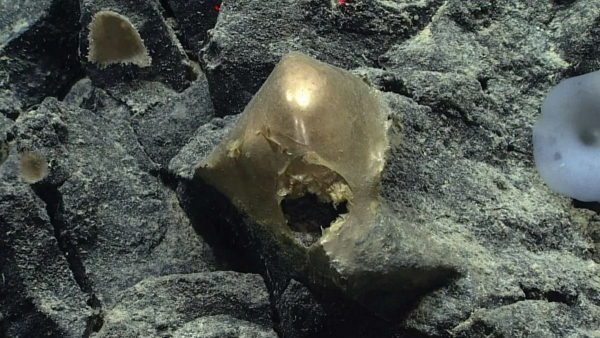
Object found in the ocean in 2023 / NOAA Ocean Exploration
In 2023, during an expedition off the coast of Alaska, researchers discovered a mysterious golden hemisphere with a hole at a depth of more than three kilometers. The find immediately gave rise to many theories, from the eggs of unknown monsters to the remains of ancient civilizations, but the truth turned out to be much more complicated.
What was the golden sphere hiding?
During the Seascape Alaska 5 mission, conducted by the National Oceanic and Atmospheric Administration (NOAA) on the Okeanos Explorer vessel, the remotely operated vehicle Deep Discoverer recorded an unusual object at a depth of 3,250 meters. A shiny golden ball with a diameter of about 10 centimeters was firmly attached to the rock among small glass sponges. Scientists who watched the live broadcast from the ocean floor were puzzled by the appearance of the find, writes ScienceAlert.
One researcher even expressed concern that the situation resembled the beginning of a horror movie, where someone could crawl out of such an object if touched. A noticeable hole on the surface of the sphere only fueled interest: experts suggested that it could be an abandoned eggshell.
Using a robotic suction-operated arm, the specimen was carefully lifted to the surface for further study in the laboratory at the Smithsonian National Museum of Natural History. While initial identifications on board the ship ranged from microbial film to sponge, detailed analysis of morphology and genetics revealed a very different result.
The object lacked typical animal anatomical features such as a mouth or muscles, but instead consisted of a fibrous material with a smooth, multilayered surface. Microscopic examination revealed the presence of spirocysts, special stinging cells unique to the class Hexacorallia.
Mysterious golden substance: watch the video
The crucial step was whole-genome sequencing, as surface DNA tests were inconclusive due to the large number of microorganisms that had settled on the object. The study confirmed that the golden ball is an organic relic, namely the cuticle of the deep-sea anemone Relicanthus daphneae, writes IFLScience.
This species was first described in 2006 and is one of the largest polyps among anthozoans: its body diameter can reach 0.3 meters, and its thin tentacles grow up to 2 meters long. Although Relicanthus daphneae is common in the oceans at depths of 1,667 to 3,948 meters, finding its cuticle separate from the animal itself is very rare.
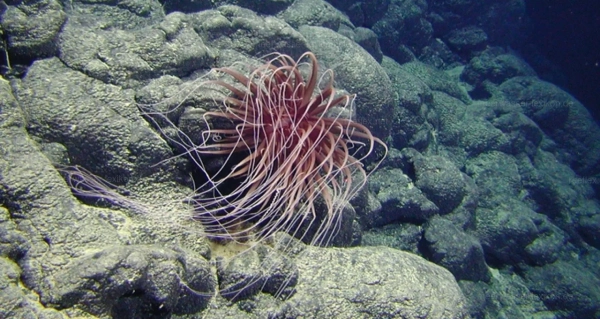
Relicanthus daphneae / Photo by Hawaii Undersea Research Laboratory (HURL)
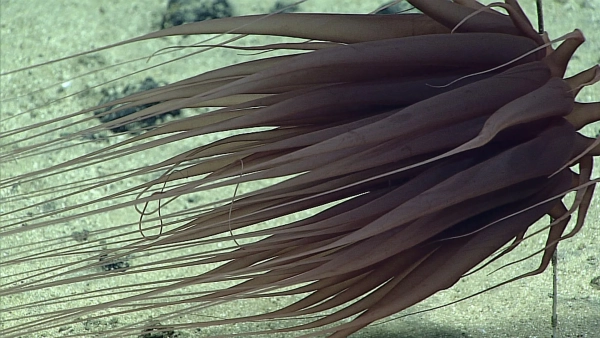
Relicanthus daphneae / Photo by NOAA
The cuticle is a thin protective coating secreted by the outer tissues of an anemone. It is composed primarily of chitin, a tough material also found in the shells of beetles and the cell walls of fungi.
Scientists believe that the anemone may have left its “golden skin” behind during movement or as a result of the reproductive process. Some species of anemone are capable of the so-called pedal laceration: they leave part of their sole on the substrate, from which a new polyp can later grow.
The resulting images of the bottom confirm this theory, showing golden tracks trailing behind a living animal as it moves across the rocky surface.
Beyond the biological origins of the sphere itself, the scientists found it to be a veritable “hotspot” of microbial activity in the cold abyss. The abandoned anemone tissue becomes home to a whole community of bacteria and archaea that participate in the nitrogen cycle by breaking down organic proteins, according to the study, a non-peer-reviewed version of which is currently published on bioRxiv.
Thus, what initially seemed like a mysterious artifact turned out to be an important link in the deep-sea ecosystem, transforming dead tissue into a microscale biogeochemical reactor.