
Main points
- Traces of ballpoint pen ink have been found in Martian meteorites, casting doubt on the purity of data from such samples.
- The study highlighted the need to develop standardized methods for processing space materials to avoid contamination with terrestrial impurities.
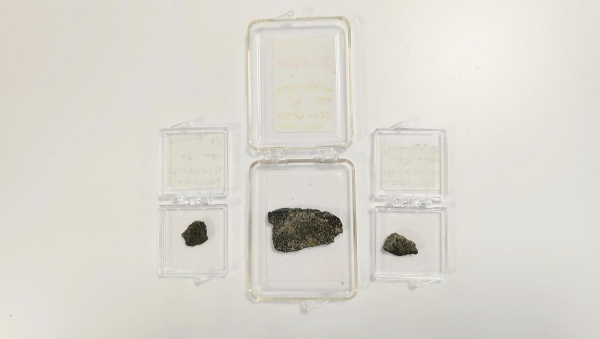
Martian samples found to be contaminated with ink / Egoi Markaida
A study of Martian meteorites has yielded an unexpected result: traces of ballpoint pen ink were found in the samples. The discovery has forced scientists to reconsider their approaches to processing space materials and has called into question the purity of data obtained from such samples.
This is reported by Daily Galaxy, citing a recent study by scientists.
What did researchers find in Martian samples?
Scientists from the University of the Basque Country have reported an unusual problem in the study of Martian meteorites – traces of ballpoint pen ink were found in samples that were thought to be thoroughly cleaned. The work was published in the journal Applied Geochemistry, and it has already sparked debate in the scientific community.
The six fragments of Martian meteorites were collected between 2001 and 2014. Before analysis, they were processed using standard methods: ultrasonic cleaning and cutting with diamond tools to get to the internal structure. Such procedures were supposed to remove any foreign impurities. But, as the study showed, this was not enough.
During the analysis using Raman spectroscopy, scientists found not only minerals of Martian origin, but also substances that clearly have an earthly source. Among them are copper compounds, organic components of ballpoint and gel pen ink, as well as synthetic polyester fibers, probably from textiles. In other words, some of the “Martian” material turned out to be contaminated during work on Earth.
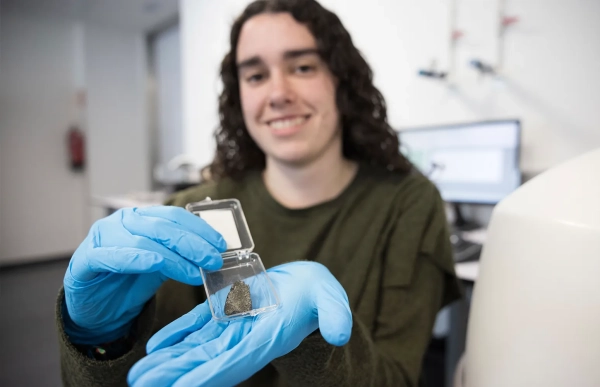
Leire Coloma, a graduate student, demonstrates samples of extraterrestrial objects or meteorites / Photo by Egoi Markaida
One of the key points of the study is the process of preparing the samples themselves. When meteorites pass through the Earth's atmosphere, they are subjected to intense heat and pressure, which causes an altered crust to form on the surface. This must be removed to study the original composition of the rock. But it is this stage, as it turned out, that poses the greatest risks of contamination.
Why did this even happen?
Researcher Leire Coloma explains that even the most meticulous methods do not guarantee complete purity. Instruments, the laboratory environment, and even the people working with the materials can leave microscopic traces that then distort the results of the analysis.
This problem is becoming especially acute with future missions to return samples from Mars. In particular, the Perseverance rover mission is already collecting materials that are planned to be delivered to Earth. If processing protocols are not improved, there is a risk that even the most valuable samples will be partially “mixed” with terrestrial impurities.
The authors of the study emphasize that today there is no single standardized approach to the preparation of such materials. Each laboratory uses its own methods, which complicates quality control and increases the risk of errors. That is why scientists call for the creation of clear rules aimed at minimizing contamination.
The discovery of ink in Martian meteorites may seem like a small thing, but it's actually a big signal. If even such apparently foreign substances end up in the samples, less noticeable impurities could go unnoticed—and affect conclusions about the geology or even potential traces of life on Mars.