
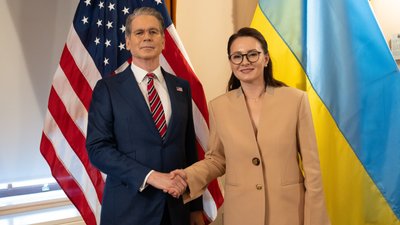
Prime Minister Yulia Svirydenko concluded her visit to the United States by reporting “positive talks” with American officials, including Treasury Secretary Scott Bessant, who, she said, “supports war-torn Ukraine.”
Reuters writes about this.
Svyridenko said that she used the meeting with Bessent to convey Ukraine's position that the sanctions imposed against Russia should not be eased, lifted, or postponed.
“I think Secretary Bessent supports Ukraine and stands up for Ukraine… It was a very friendly discussion, and he is very supportive. I think all of our colleagues here in the United States … understand this very well: that preventing the circumvention of sanctions, as well as strengthening sanctions, is an extremely important measure that should be taken to make Russia weaker,” Svyridenko said.
During the visit, they also discussed cooperation with the International Monetary Fund. According to Svyrydenko, a mission of IMF experts will arrive in Kyiv in May. She also reported on progress in negotiations on an $8 billion loan and noted that the IMF is ready for some flexibility on certain issues.
Overall, the Prime Minister noted that after two days of intensive meetings in Washington, she felt a new wave of support, and the mood of the partners became more constructive compared to previous visits.
“My first feeling after two days is that the situation has changed,” Svyridenko noted.
In addition, she expressed hope that the outcome of the parliamentary elections in Hungary and the election of future Prime Minister Peter Magyar will help unblock the 20th package of EU sanctions against Russia, as well as the 90 billion euro EU loan that Hungary is blocking.
At the same time, Svyrydenko added that this could be a positive signal for Ukraine's “irreversible” path to the EU.
“All Ukrainians feel part of the EU family, and I think they deserve to be there. So, now is the time for us to move faster and have a fast track for our integration into the EU,” the Prime Minister said.
In turn, Bessent reported on the social network X that during a meeting with the Ukrainian Prime Minister, he emphasized the efforts of American leader Donald Trump to achieve lasting peace in Ukraine and stressed the importance of continuing economic cooperation between the United States and Ukraine.
“The U.S.-Ukraine Reconstruction Investment Fund is the centerpiece of Ukraine's reconstruction efforts, and the approval of the first URIF investment in March was an important step,” the U.S. Treasury Secretary added.
What is known about preparations for the new IMF program?
In November 2025, Ukraine and the IMF agreed on the parameters of a new four-year, $8.1 billion extended financing program. The program included 16 structural benchmarks to be implemented by the government and the Verkhovna Rada, as well as four mandatory preconditions, without which the program cannot be launched.
In December 2025, the Ministry of Finance submitted for public discussion a draft law on the mandatory payment of VAT by individual entrepreneurs with an annual income of over 1 million hryvnia.
After the negative reaction, the Ministry of Finance began preparing a softened version, which provides for raising the threshold to 2 million hryvnias or 4 million hryvnias per year, said David Arakhamia, head of the Servant of the People faction, Bloomberg reported.
On February 14, Prime Minister Yulia Svirydenko, while talking to reporters, announced that the IMF had agreed to cancel the prior actions for the new loan program. These included requirements for the introduction of VAT for individual entrepreneurs, customs duties on parcels, a tax for digital platforms, and the preservation of military levies.
On February 27, the IMF agreed to a new extended financing program for Ukraine. It is designed for four years, and amounts to $8.1 billion, which will partially cover the Ukrainian budget deficit.
On March 3, Ukraine received $1.5 billion from the IMF as the first tranche under a new four-year program under the Extended Fund Facility (EFF).
On March 10, the Verkhovna Rada failed to pass a bill on taxation of income from digital platforms, one of the requirements of the IMF program. In general, the parliament must support a number of decisions to receive macro-financial assistance.
Previously, Suspilne explained whether there was a threat of losing funding from the IMF due to the parliamentary crisis.