
Main points
- Scientists from the University of Vienna have recorded a hexatic phase, an intermediate state between a solid and a liquid, during the melting of ultrathin crystals.
- The discovery was made possible by an electron microscope and artificial intelligence, which allowed observing the behavior of atoms in a thin layer of material.
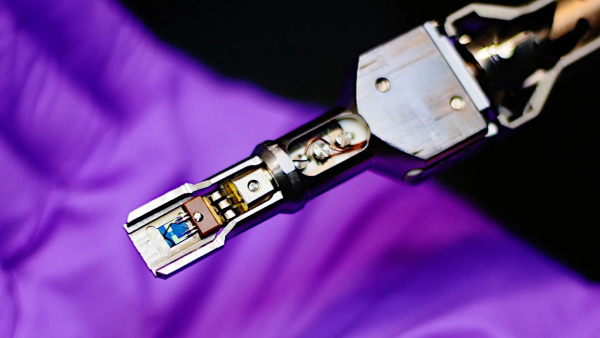
Artificial intelligence helped discover an intermediate phase of matter / Jani Kotakoski
Scientists from the University of Vienna have recorded a rare state of matter that occurs during the melting of ultrathin crystals. This phase, called hexatic, is an intermediate stage between a solid and a liquid.
Using an electron microscope and artificial intelligence, researchers were able to see with their own eyes how individual atoms behave in a material just one layer thick, Science Daily reports.
What is the discovery?
In our everyday world, the melting process seems instantaneous: as soon as the temperature reaches a certain point, ice immediately turns into water, losing its rigid structure.
This is how almost all three-dimensional objects behave, from metals to minerals. However, at the atomic level, when a material becomes extremely thin, the rules of the game change.
Instead of a sharp transition from one state to another, a strange intermediate form appears – the hexatic phase , and it is this that scientists have finally managed to record.
What is this “hexatic phase”?
This unusual state was predicted back in the 1970s, but its existence in real materials with strong chemical bonds has not yet been confirmed.
The hexatic phase is a true hybrid: the spacing between particles becomes chaotic, like in a liquid, but the angles between them remain partially ordered, as is typical of solids. This confirms that even in strongly bound crystals, such an elusive state can exist.
To see this process, an international team of researchers designed a unique experiment. They placed a one-atom-thick layer of silver iodide (AgI) between two sheets of graphene, creating a kind of “protective sandwich.”
This design protected the crystal lattice from destruction, allowing it to melt naturally. Using a scanning transmission electron microscope (STEM), the scientists gradually heated the sample to an incredible 1,100 °C.
How was the discovery made and what is the use of AI here?
Modern data processing technologies played a key role in the discovery. Kimmo Mustonen from the University of Vienna noted that without the help of artificial intelligence, tracking the movement of each individual atom would simply be impossible.
Neural networks analyzed thousands of high-resolution images, which allowed them to capture the hexatic phase in a narrow temperature window – approximately 25 °C before the substance completely melted.
The results of the study, published in the journal Science, surprised scientists. Older theoretical models claimed that the transition from solid to hexatic and then to liquid should be gradual.
In fact, it turned out that only the first stage is smooth, while the transformation of the hexatic phase into a liquid occurs suddenly.