
Main points
- Scientists have discovered a 550-million-year-old fossil sea sponge, explaining a gap in the fossil record due to their soft structure, which hindered preservation.
- The find changes the approach to searching for the oldest forms of life, indicating the need to search for rare preservation conditions where soft-bodied organisms could survive.
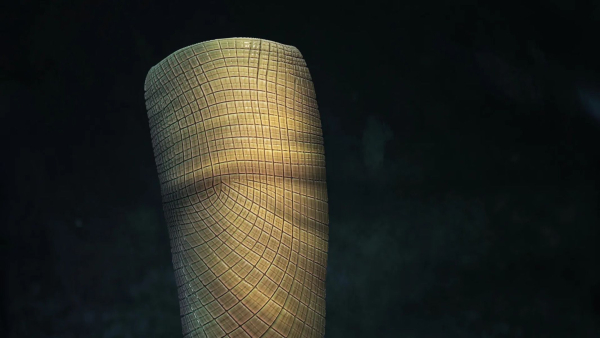
Ancient sponge explained the disappearance of the first animals from the Earth's history / Sciencedaily
Scientists have discovered a 550-million-year-old fossilized sea sponge that helps explain a mysterious gap in the fossil record. It turns out that the earliest sponges may have been too soft to survive to this day.
A new discovery has helped solve one of the long-standing mysteries of evolution. Scientists have long believed that sea sponges appeared about 700 million years ago , but the oldest convincing fossils date back only about 540 million years . This created a 160-million-year gap that remained unexplained. This is reported by ScienceDaily .
Why did the first sponges disappear from the fossil record?
A study published in Nature describes the discovery of a 550-million-year- old sponge – from a period thought to be “lost.” It helps explain why older specimens are so rare.
A team led by Shuhai Xiao of Virginia Tech concluded that the first sponges may not have had a mineral skeleton. Unlike modern species, which have hard elements called spicules, the early organisms were likely composed only of soft tissue.
This means that they had virtually no chance of being preserved in the fossil state, as soft bodies decompose quickly. Only under exceptional conditions – for example, very rapid burial – could such organisms have left a trace.
This idea is consistent with data from the so-called molecular clock , a method that estimates the time of the emergence of species based on genetic changes, which pointed to an earlier origin of sponges than fossil evidence indicated.
The rare find was made in the Yangtze River region of China . Researchers first noticed the specimen about five years ago when they received images of it.
According to Xiao , it was a unique case – he had never seen anything like it before. Initially, the scientists considered various options, including sea anemones or corals, but none of them seemed to fit. As a result, they concluded that it was an ancient sponge.
According to Nhm , the shape and structure of the find also surprised the researchers. The surface of the fossil organism is covered with a regular pattern of rectangular elements resembling a grid. This structure indicates a relationship with the so-called glass sponges.
Even more surprising was the size – about 38 centimeters in length . Previously, scientists had assumed that the most ancient sponges should have been much smaller and simpler in structure.
Researchers from the University of Cambridge and the Nanjing Institute of Geology and Paleontology also participated in the discovery.
The discovery changes the approach to searching for the earliest forms of life . If early sponges were soft-bodied, most of them may have disappeared without a trace. This means that scientists need to look not only for traditional fossils, but also for the rare preservation conditions where such organisms could have survived.
Thus, the new discovery not only fills a gap in evolutionary history, but also helps to better understand how exactly the first animals appeared on Earth.