
Main points
- In Russia, the delivery times and costs of household appliances have increased sharply due to the conflict in the Middle East.
- Logistics disruptions could lead to a 10-15% increase in prices for household appliances in Russia by the end of spring.
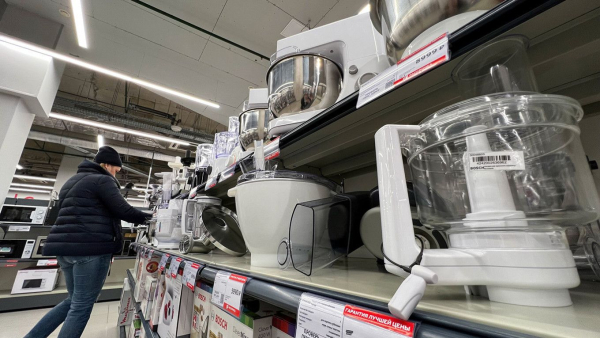
Russia will be left without household appliances due to the war in the Middle East / Russian media
In Russia, delivery times for European home appliance brands that have left the market have increased dramatically. These include Siemens, Bosch, AEG, Miele, Dyson, and others.
What is happening with the supply of household appliances in Russia?
Since the end of February, delivery times have increased by 1.5-3 times, while the cost of logistics has increased by up to 200%, writes The Moscow Times.
The cause of the problems was the conflict in the Middle East:
- Dubai is a large logistics hub: goods were distributed through it for delivery to Russia.
- Up to 60-70% of European household appliances were imported through parallel imports through this route.
- The UAE used to be a key hub for supply and a disruption in this direction could lead to a price increase of up to 20%.
“Logistical costs for deliveries through the UAE were lower than through other channels, such as Turkey. In the case of parallel imports, this is an important component of the final price,” says Serhiy Polovnikov, head of the Content-Review project.
Parallel imports of household appliances from manufacturers that left Russia went through the Persian Gulf countries. Now it has practically stopped, so sellers are looking for alternative supply routes, but this means rising prices.
- As a result, by the end of spring , the price of household appliances in Russia may increase by 10-15% due to the lengthening of supply chains and the emergence of new intermediaries.
What is Putin and Russia afraid of now?
The Russian side has long claimed that it has unique technologies to counter missiles and drones. However, it turned out that over the past year, the Ukrainian military-industrial complex has made a leap forward. Now the Russians have many new problems that they cannot counteract. Journalist Oleksandr Demchenko told Channel 24 in more detail.
The defense forces continue to launch intensive strikes on Russian ports. There is a de facto oil blockade of five regions of Russia. In addition, almost all supplies of liquefied Russian gas are blocked. This is precisely what Putin tried to blackmail Europe with.
Putin is now very afraid of the creation of Ukrainian missiles and the fact that Ukraine will put their production on the assembly line,
– said Demchenko.
There is also another equally important event – a strike on two refineries in the Nizhny Novgorod region. One of these refineries is the Lukoil enterprise. It processes 17 million tons of oil and provides Moscow with 30% of its gasoline. Accordingly, a serious problem is brewing and a shortage may arise.
Latest news on the conflict between the US and Iran
-
Donald Trump promised to block the Strait of Hormuz and implemented his plans. On April 13, the US sent recommendations to Iranian ports. Iran threatens to retaliate if the US blocks the Strait of Hormuz to Iranian ships. Tehran says such a blockade could negatively affect all ports in the Persian Gulf.
-
The Israel Defense Forces have been placed on high alert following the breakdown of talks between the US and Iran. The military is stepping up operational planning and preparing for a possible resumption of hostilities as the situation in the region remains tense.
-
Trump has singled out desalination plants, energy infrastructure, and bridges in Iran as potential military targets. He argues that much of Iran's infrastructure has already been destroyed and that the US could strike additional sites if there is further escalation.
-
Trump announced that the United States would impose a 50% tariff on goods from countries that support Iran or supply it with military equipment. The US president said that China could be among the countries that would face punishment.