
Main points
- The Artemis II mission will be the first manned mission to the Moon since Apollo 17 in 1972, with the goal of testing the Orion spacecraft's systems in real-world deep space conditions.
- The launch took place on April 1, 2026, after numerous postponements due to technical difficulties, including problems with the heat shield and fuel tanks.
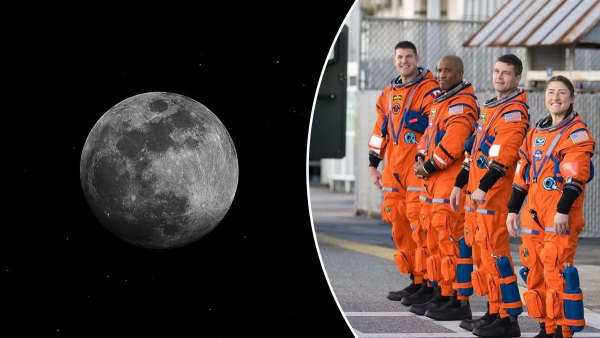
Return to the Moon: How Artemis 2 Will Change the History of Space Exploration / Channel 24 Collage
After decades of waiting, humanity is once again returning to the Moon. The Artemis 2 mission is set to be the decisive step that will pave the way for a long-term presence on Earth's moon. It is a test not only of technology but also of the endurance of the first international crew to orbit the moon and return home.
Why do we need the Artemis 2 mission?
The Artemis 2 mission is the first manned mission in NASA's modern lunar program, using the powerful Space Launch System (SLS) rocket and the Orion spacecraft. It is the first time since Apollo 17 in 1972 that humans will leave the vicinity of Earth to head for the Moon, writes 24 Kanal .
The main goal is to test all critical systems of the spacecraft, including life support, communications and navigation, in real-world conditions of deep space. Unlike the previous unmanned mission Artemis 1, this time Orion will be fully equipped to accommodate humans, but they will not land on the surface of the satellite. Instead, astronauts will fly around the Moon and return to Earth. The landing will be carried out by the Artemis 3 mission.
Artemis 2 mission crew
The crew of the current mission consists of four experienced astronauts: Commander Reed Wiseman, Pilot Victor Glover, and Flight Specialists Christina Koch and Jeremy Hansen.
This lineup is historic, as Victor Glover will become the first black person, Christina Koch the first woman, and Jeremy Hansen the first non-American (he is a Canadian) to travel to the Moon.
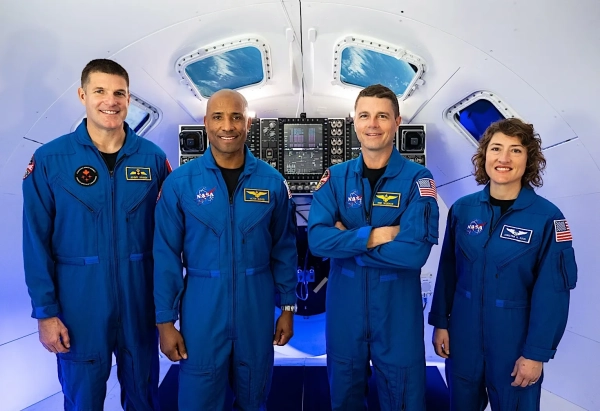
Artemis II crew: Jeremy Hansen, Victor Glover, Reed Wiseman, Christina Cook / NASA photo
The Canadian astronaut's participation was made possible by an agreement between the United States and Canada, which also includes the development of the Canadarm3 robotic system for the future Gateway station.
What do we know about the SLS rocket?
The Space Launch System (SLS) is a super-heavy launch vehicle designed for manned missions to deep space, and is the most powerful rocket in operation today, according to NASA. Technologically, the SLS is based on the unfulfilled plans for the Ares-5 rocket and uses the main engines and solid-fuel boosters from the Space Shuttle program, which ended in 2011.
Rocket specifications
The basic modification of SLS (Block 1) has a height of 98 meters and is capable of delivering up to 95 tons of cargo to low Earth orbit and up to 27 tons of cargo to a flight trajectory to the Moon.
The first stage is 65 meters tall and 8.4 meters in diameter, and is powered by four RS-25 liquid engines that run on liquid hydrogen and oxygen. Two solid-fuel side boosters consist of five segments each and provide increased thrust compared to the shuttles.
The SLS generates about 4,000 tons of thrust during launch , which is 15% more than the legendary Saturn V rocket used in the Apollo program. The total thrust allows the launch vehicle to reach low Earth orbit in just eight minutes. This is equivalent in power to keeping eight Boeing 747s in the air at the same time.
The rocket development program since 2011 has cost $23.8 billion , and the Orion spacecraft has cost $20.4 billion . Each launch is estimated to cost about $4 billion.
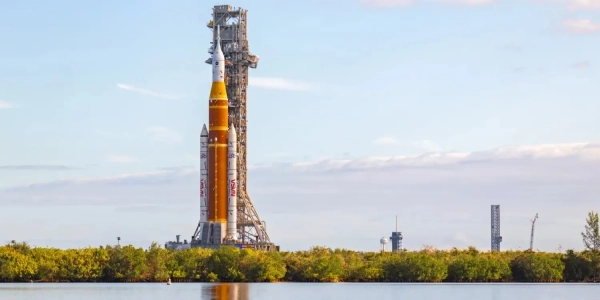
The Space Launch System is now in place and preparing for final tests / Photo Steven Madow/Space Explored
The rocket is designed as a modular system with the ability to upgrade to more powerful configurations. The Block 1B version, which will be used starting with the Artemis IV mission, will increase the payload to 105 tons to low Earth orbit and to 42 tons for a flight to the Moon.
The most powerful Block 2 version will be able to lift up to 130 tons to low Earth orbit and up to 46 tons during missions to the Moon, which puts it on par with the Saturn V's payload capacity.
The rocket has already successfully completed its first launch, delivering the Orion spacecraft into space, which has traveled more than 450,000 kilometers from Earth.
What is known about the Orion spacecraft?
The Orion spacecraft is specifically designed for extra-orbital missions to the Moon and Mars. Engineers designed it to withstand and overcome the extreme temperatures of space, which is why it has a very shiny appearance.
The spacecraft has been equipped with a next-generation heat shield to protect the crew inside during the return home. As part of the Artemis II mission, Orion will orbit the Moon and return to Earth—it already did so during the Artemis I mission, but now there will be a team of astronauts inside.
The capsule of the ship has a fuse in case of unforeseen situations or malfunctions. In the event of anomalies during launch, an emergency abort system will be used, which will “shoot” the astronauts to a safe place. In space, the ship can support the life of four people for 21 days , but the mission itself will last 10 days, NASA writes.
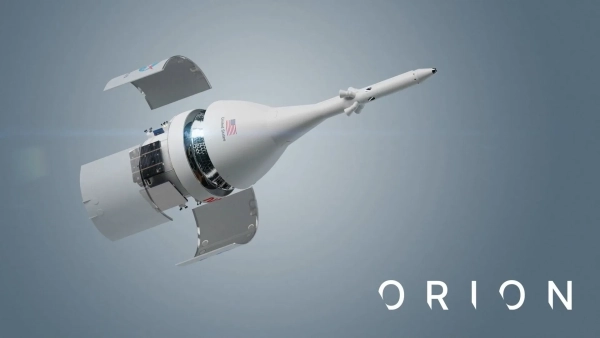
The Orion spacecraft, which will house astronauts/ Photo by NASA
What is the Artemis II mission plan?
The ten-day flight plan involves several stages:
- After launching from Launch Complex 39B in Florida, the spacecraft will enter an elliptical orbit around the Earth.
- During the first day, the crew will check life support systems and perform approach maneuvers with the ICPS upper stage, using it as a target.
- Only after confirming the health of all systems will Orion start the engine to transition to the flight trajectory to the Moon.
- The spacecraft will fly within about 6,513 kilometers of the far surface of the Moon, using its gravity to return home.
- In the final stage, Orion will perform a “jump” reentry to land more precisely in the Pacific Ocean near San Diego.
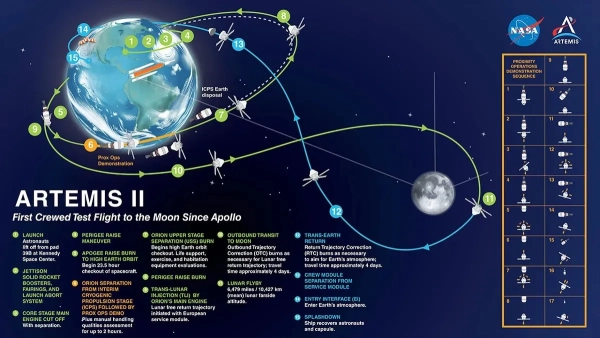
Artemis II flight plan / NASA photo
What were the previous stages of preparation?
The road to final preparations was not easy. The Artemis 2 mission faced numerous technical difficulties, leading to several postponements of the launch date.
The main reason for the delays was problems with the Orion spacecraft's heat shield. During the Artemis 1 mission, the Avcoat epoxy resin used as the primary material for the heat shield did not behave as expected – gases trapped in the material damaged the coating during atmospheric reentry.
Although the investigation showed that replacing the heat shield was not necessary (which would have delayed the mission by another year), the team still needed additional time to prepare. Instead of completely replacing the shield, NASA decided to change the reentry trajectory to reduce thermal loading.
In addition, the engineering team encountered a number of issues that needed to be resolved before the planned flight date. Other critical issues included:
- Orion spacecraft battery malfunctions.
- Problems with the life support system (ECLSS), in particular with the valve motor controllers
- Failure of the drive chains of the motor valves in the carbon dioxide removal system.
- Problems with the oxygen regulator.
All of this has long since been fixed, but it delayed the launch at the time. Artemis II was originally scheduled for September 2025.
- In December 2024, it was postponed to April 2026.
- The first launch period in 2026 has been set for February, with specific opportunities on February 6, 7, 8, 10, and 11.
- However, everything fell apart again and was postponed to March 2026 due to a liquid hydrogen leak during a critically important test – a “wet” dress rehearsal.
Despite all these difficulties, the success of Artemis 2 will pave the way for landing humans on the surface of the Moon as part of the Artemis 4 mission, building the first colonies, and then on to Mars.
Date of flight to the Moon
NASA successfully launched the Artemis 2 mission on the night of April 1-2 at 01:35 Kyiv time. The rocket launched from Florida, opening a new page in the history of deep space exploration.
The next steps are already set. Artemis 3 is to demonstrate docking with lunar landers being developed by SpaceX and Blue Origin. Artemis 4 is planned to land astronauts near the Moon's south pole.