
Main points
- Scientists have discovered giant dinosaur footprints on the ceiling of the Castelbucque Cave in France, which were formed millions of years ago.
- Analysis showed that the tracks belong to titanosauriform sauropods, and the exceptional preservation allowed the identification of a new ichnotaxon “Occitanopodus”.
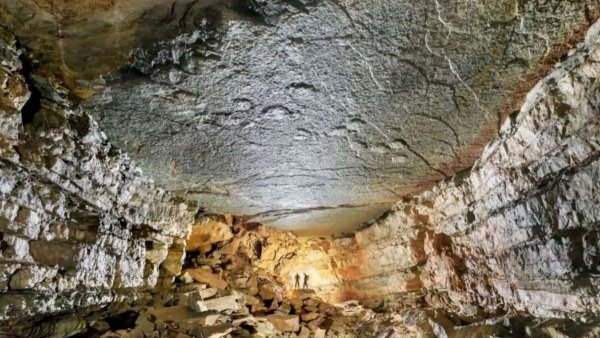
Traces of prehistoric giants: how dinosaur footprints ended up on the cave ceiling / Remi Flaman
During a scientific expedition in a remote region of France, researchers have stumbled upon an unusual phenomenon hidden deep beneath the Earth's surface. A hard-to-reach cave system has preserved evidence of life that existed millions of years ago, challenging conventional wisdom about archaeological finds.
Why did the paw prints end up above the researchers' heads?
The unusual find was recorded in the Castelbucque cave, located in the Coss-Mejan region in southern France. The path to the place where the traces were preserved turned out to be extremely difficult: scientists had to overcome narrow, winding and often flooded passages for more than 100 meters to reach the final point at a depth of about 500 meters underground. Despite the fact that the deep galleries of natural underground cavities are dangerous and difficult to access, they have enormous potential for preserving fossils, which was confirmed by this study, writes Daily Galaxy.
What struck the researchers most was the location of the footprints – they are not even on the walls, but on the ceiling of the cave. These are not just ordinary dents on the surface, but the so-called three-dimensional counter-imprints. They were formed millions of years ago when dinosaurs walked on soft sediment, and the depressions they created were later filled with other sediments. Over time, these rocks hardened, and as a result of erosion and the formation of the karst cave, the lower layers disappeared, exposing the filled forms that now protrude from the ceiling.
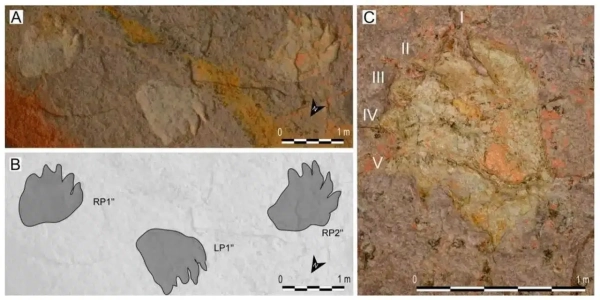
Analysis of the prints showed that some of them reach 1.25 meters in length. This indicates that they were left by representatives of titanosauriform sauropods – a group of massive herbivorous dinosaurs. Such individuals could exceed 30 meters in length and weigh up to 50 tons. The age of the find is estimated at 166 – 168 million years, which corresponds to the Jurassic period. At that time, the territory of modern France was a coastal zone, where these giants moved.
Dinosaur footprints preserved on the ceiling of Castelbuco Cave / Photo Journal of Vertebrate Paleontology
Thanks to the exceptional level of preservation, paleontologists were able to see the smallest details of the anatomy: fingerprints, paw pads, and even claw marks. In particular, one of the prints of the right hind paw clearly shows five formed toes, a rare occurrence for such fossils.
One of the three tracks found did not match any previously described sauropods from the period, allowing the scientists to identify a new ichnotaxon, which they named “Occitanopodus,” referring to the region of discovery and the unique morphology of the animal's paws.
The authors of the study, published in the Journal of Vertebrate Paleontology, emphasize that deep caves may offer much larger and better-preserved surfaces for study than open rock outcrops. The find helps fill gaps in the evolutionary history of sauropods, which remains only partially understood today, and highlights the importance of further excavations in difficult-to-access underground systems.
How did the footprints end up on the ceiling?
Dinosaurs obviously didn't walk on the ceiling. The layer of rock that now forms the top of the cave was once located below, perhaps the shore of a body of water. The soft surface from the water allowed the depressions to form.
After solidification, millions of years passed, during which the continents moved, the surfaces shifted and mixed. The former ocean floor in some places became mountains (and therefore the remains of ancient shells and fish can now be found there), and the coastal zone sank down, becoming the surface of caves.
This is probably what happened in this case. The surface with the footprints sank underground, turned over and became the ceiling of the cave, preserving the prints.