
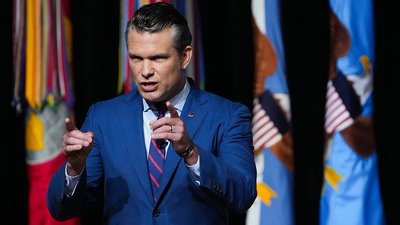
US Defense Secretary Pete Haagseth said that the agreement with Iran means Tehran's complete abandonment of nuclear weapons and the export of nuclear materials.
He said this at a press conference, Suspilny correspondents report.
Hegset noted that US and Israeli forces achieved every objective they set — “according to plan, on time, exactly as planned from the beginning.”
“The Iranian Navy is lying at the bottom of the sea, their frigates, their precious drone carriers, submarines or minelayers – everything is sunk. The Iranian Air Force has been destroyed. Iran no longer has air defense, no comprehensive air defense system. We own their skies,” the Pentagon chief said.
According to him, Iran's missile program is “functionally destroyed,” with launchers, production facilities and existing stockpiles “exhausted and destroyed, and almost completely ineffective.”
Hegset noted that Tehran launched “hundreds and hundreds” of missiles and kamikaze drones to attack the US aircraft carrier, but “didn't even come close to it.”
“The little they have left, hidden in bunkers, is all they have. They can still shoot, we know that. Their control systems are so shattered that they can't actually communicate or coordinate. They can no longer build missiles, rocket launchers or drones. Their factories have been razed to the ground, which is a historic event,” he said.
The minister reiterated that if Iran did not agree to the US conditions, the next targets would be their power plants, bridges, and oil and energy infrastructure.
“Targets that they couldn't defend, and that they couldn't really rebuild. It would take decades, and we were ready to act,” Hegset said.
According to the head of the Pentagon, a condition for peace is Iran's complete abandonment of nuclear weapons.
“They know that this deal means they will never, ever have nuclear weapons. Under the terms, any nuclear material they would have had will be removed. Right now, their remains are buried deep and under 24/7 surveillance. The president has been clear from the beginning that there will be no Iranian nuclear weapons. Period,” the minister said.
He noted that the new Iranian regime realized that the agreement was much better than the fate that awaited them and recalled the deaths of Iran's spiritual and military leaders.
Hegset emphasized that the fact that Iran cannot have nuclear weapons is not negotiable, and Tehran will voluntarily give up nuclear material.
“We will get it and we will get it out. Or, if we have to do something else on our own, like we did in Operation Midnight Hammer or something like that, we reserve that option. But it is clear that the new Iranian regime will never have nuclear weapons or the ability to pave the way to them,” the Pentagon chief said.
According to him, the new Iranian regime has “a new understanding of what it means to negotiate with us” and “has a different interaction with the United States.”
General Kane added that the two-week ceasefire is a pause, and “the combined force remains ready if ordered or called upon to resume combat operations with the same speed and precision that we have demonstrated over the past 38 days, and we hope that it does not come to that.”
Earlier, US President Donald Trump said he had agreed to halt bombing of Iran and delay the attack on it for two weeks. He said the ceasefire would be bilateral and that Iran's 10-point proposal was an acceptable basis for negotiations.
According to Trump, he did this because the US “has already met and exceeded all military objectives” and has made progress in working on a long-term settlement agreement with Iran.
Iran's Supreme National Security Council has confirmed a two-week ceasefire deal brokered by Pakistan. The Iranian side called the agreement “a victory for Iran” and added that talks on a permanent agreement would take place in Islamabad.
Israeli Prime Minister Benjamin Netanyahu's office said the country supports US President Donald Trump's decision to suspend strikes on Iran for two weeks – on the condition that Tehran “immediately opens the straits and ceases all attacks on the United States, Israel and countries in the region.”
On April 8, Trump made a statement following his announcement of a two-week ceasefire with Iran. He called it a “great day for peace around the world,” adding that Tehran's pursuit of peace paves the way for global economic change.