
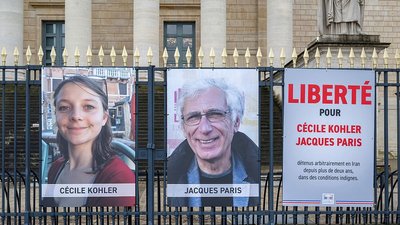
French citizens Cecile Kohler and Jacques Paris, who were detained in 2022, have been granted permission to leave Iran and are heading to France after more than three years of forced detention in its territory. Oman acted as a mediator in their release.
French President Emmanuel Macron wrote about this on the social network X on April 7.
“Cecil Kohler and Jacques Paris are free and heading to France after three and a half years of captivity in Iran,” the French president wrote.
Macron called the release of Kohler and Pari “a relief for everyone and, of course, for their families.” He thanked the Omani authorities for their mediation, as well as the public services and citizens who, he said, had worked tirelessly to secure the return of the detainees.
On March 16, Macron called on Iranian President Massoud Pezeshkian to allow Cecile Kohler and Jacques Paris to return to France as soon as possible.
Cecile Kohler is a 41-year-old French teacher, and Jacques Paris is her 72-year-old partner, a retired teacher. Iranian authorities detained them while on a tourist trip in May 2022 on charges of espionage. In October 2025, an Iranian court sentenced Kohler to 20 years in prison, and Paris to 17 years. In November 2025, both were released from a Tehran prison and transferred to the grounds of the French embassy in Tehran, but Iran did not allow them to leave the country.
Israeli and US military operation against Iran
On February 28, Israel attacked the Iranian capital Tehran. US President Donald Trump later said that the US military had launched a “major combat operation” against Iran to “eliminate imminent threats from the Iranian regime”. He accused the Iranian government of “funding and training” militants in Syria, Lebanon, Iraq and Hamas in Palestine. According to him, the aim of the military operation is to “destroy Iran's missile industry and navy” and “ensure that the world cannot be destabilised”.
The Islamic Revolutionary Guard Corps (IRGC) said it had launched missiles and drones towards Israel, and also attacked US military bases in Qatar, Saudi Arabia and the United Arab Emirates.
Amid the US military operation against Iran, French President Emmanuel Macron said that Paris is calling for an urgent meeting of the UN Security Council.
The European Union said it reaffirmed its “unwavering commitment to ensuring regional security and stability” in the Middle East.
Ukrainian President Volodymyr Zelenskyy said it was fair to give the Iranians a chance to get rid of “the terrorist regime and guarantee the security of all peoples who have suffered from attacks from Iran.”
On February 28, Trump announced that Iran's Supreme Leader Ali Khamenei was dead, a claim later confirmed by the Islamic Republic News Agency (IRNA).
On March 1, the IRGC announced that it was launching “the most devastating offensive operation in the history of the Islamic Republic” against Israel and “American terrorist bases.” Trump called on the Iranian regime to abandon these plans and threatened to strike “a very strong blow” in response.
On March 2, US Secretary of State Marco Rubio said that the next phase of the US military operation against Iran would be even more destructive.
On March 6, Trump declared the need for a complete change in Iran's leadership, adding that he already had several candidates for the role of “a good leader.”
On March 8, Iran's Assembly of Experts elected the son of the assassinated Ayatollah Ali Khamenei, Mojtaba Khamenei, as the third supreme leader of the Islamic Republic.
Trump declined to comment on the election of Mojtaba Khamenei, saying only: “We'll see what happens.” Before that, the American president said that the new leader of Iran “won't last long” if he doesn't receive the approval of the White House.
On March 26, President Trump announced that he was suspending the destruction of Iranian energy facilities until April 6. He said he made this decision at the request of the Iranian government, and negotiations are ongoing.
On April 7, Trump announced that he had agreed to suspend bombing of Iran and postpone a “devastating attack” on it for two weeks if the Strait of Hormuz was unblocked. He said the ceasefire would be bilateral and that Iran's 10-point proposal was an acceptable basis for negotiations.
Iranian Foreign Minister Abbas Araqchi said that safe passage through the Strait of Hormuz within two weeks is possible “under the conditions of coordination with the Iranian armed forces and taking into account technical limitations.”