
Main points
- The Artemis 2 mission will test technologies for long-distance flights and collect important data on the effects of space on humans.
- Astronauts will conduct experiments on tissue research, behavior in confined spaces, immunity, radiation, and will explore the far side of the Moon.
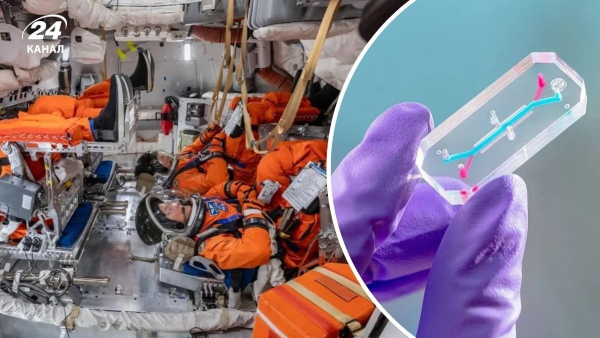
The Artemis 2 mission will not only be a historic return of humans to the Moon, but also a large-scale scientific experiment. During the 10-day journey into deep space, astronauts will virtually become participants in research that will help prepare future flights to the Moon and Mars.
The Artemis 2 mission has a dual purpose: testing technologies for long-distance flights and at the same time collecting critical data on the impact of space on humans, explains Channel 24 .
What exactly will they study during the flight?
The crew of Reed Wiseman, Victor Glover, Christina Koch and Jeremy Hansen will spend about 10 days in space, orbit the Moon and return to Earth. That's the plan for the Artemis 2 mission, but it will also include a number of science experiments, Space.com reports.
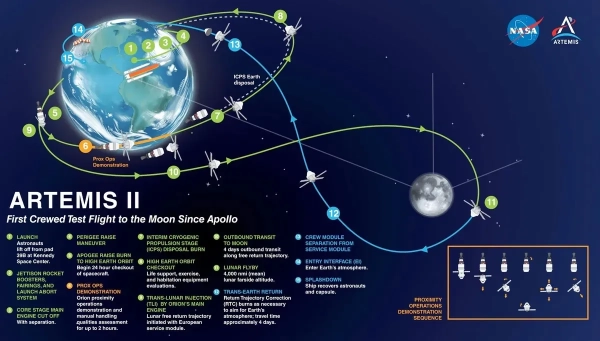
Artemis 2 flight path / NASA photo
Body research: bone marrow and cells
One of the key experiments will be AVATAR, a study of lab-grown tissues. These are small models of organs with living human cells, including bone marrow, which is responsible for producing blood and immune cells, NASA explains.
Because bone marrow is particularly sensitive to radiation, scientists want to understand how it works during a flight outside the Earth's magnetic field. Upon return, these samples will be compared with data obtained on the International Space Station, as well as with analyses of the astronauts themselves before and after the mission.
Stress, sleep and working in confined spaces
Another important experiment, ARCHeR, is studying human behavior in the cramped Orion spacecraft. Astronauts will wear special sensors that will record stress levels, sleep quality, physical activity, and even cognitive performance, according to a separate NASA ARCHeR experiment page.
This data will help understand how isolation, confined space, and workload affect teamwork and mental state – a critical factor for long-duration missions, including a flight to Mars.
How the impact of deep space flights on astronauts will be studied – watch the video:
How immunity changes in space
During the mission, astronauts will regularly take saliva samples to monitor changes in the immune system. It is known that dormant viruses, including those that cause chickenpox and shingles, can be activated in space.
Comparing biomaterials before, during, and after the flight will allow us to understand how radiation, stress, and isolation affect immunity.
Radiation is the main threat
Unlike the crew of the International Space Station, which is protected by the Earth's magnetic field, the mission participants will be heading into a much more dangerous environment.
Astronauts will have personal dosimeters that will record radiation levels in real time. Additional sensors inside the ship will help detect sudden spikes, for example during solar storms.
This data will form the basis for the development of protection systems during future long-duration missions.
A new look at the Moon
During the flyby of the far side of the Moon, the crew will have a rare opportunity to explore regions that humans have barely seen in over 50 years. The astronauts will photograph the surface and describe geological features.
How the mission around the Moon will go – watch NASA's video:
Among the main features is the Orientale Basin, a giant crater about 960 km in diameter that formed about 3.8 billion years ago. It is also possible to observe meteorite impacts or mysterious dust phenomena above the surface.
The data obtained will help identify the most interesting regions for future landings under the Artemis program, in particular near the Moon's south pole.