
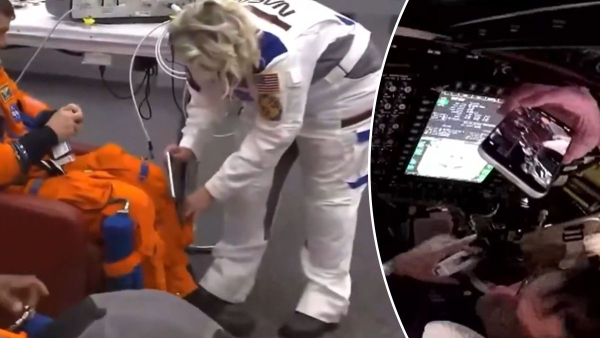
Astronauts of the Artemis 2 mission use iPhone in orbit / Collage of Channel 24/NASA/Screenshots of Channel 24
On April 1, the Space Launch System rocket successfully launched a spacecraft carrying four astronauts into space. The launch marked the beginning of a 10-day journey around the moon, the first manned mission to that destination in more than 50 years. But the attention of technical experts was not only focused on the SLS engines, but also on the unusual contents of the spacesuit pockets.
How will ordinary smartphones help humanity better experience the atmosphere of a lunar mission?
Each crew member was issued with a modern iPhone 17 Pro Max smartphone. They were carefully packed into their suits before launch, and then appeared in footage shot inside the Orion capsule, TechRadar writes.
The decision represents a fundamental shift in how space agencies approach the process of documenting events. In early 2026, NASA Administrator Jared Isaacman introduced a new policy that allows astronauts to bring familiar consumer devices with them. The primary purpose of using the iPhone is to create high-quality images and record personal moments during the historic flyby of the Earth.
Representatives of the space agency are convinced that this approach will help to reduce the distance between complex scientific operations and the everyday lives of audiences on Earth. The use of devices that are in almost everyone's pocket makes space exploration closer and more understandable for millions of viewers.
iPhone 17 Pro Max is put into spacesuits, and then they appear in footage from orbit: watch the video
NASA astronauts are given silver iPhone 17 Pro Max for the Artemis II flight!
Could the same phone we use be used to take pictures of the Moon?
Look at how it's floating in zero gravity, this could be the ultimate Shot on iPhone commercial pic.twitter.com/gQzrR6miDP
— Shishir (@ShishirShelke1) April 2, 2026
Despite the use of consumer electronics, safety remains a priority. All smartphones on board operate exclusively in flight mode, notes IndiaToday. This ensures that wireless signals will not interfere with the spacecraft's complex systems or attempt to connect to ground networks.
In fact, these gadgets have evolved into standalone cameras and video recording tools that rival some professional equipment, such as still cameras. Their compactness and ease of use allow crews to quickly capture unique shots without the distraction of setting up specialized equipment.
In addition, smartphones are much lighter, which is critically important in the case of space launches, where every gram counts.
They are already working, but this is just the beginning
The first results of this initiative have already appeared on the Internet. Social media has been flooded with footage of astronauts testing their smartphones in zero gravity. One video shows an iPhone moving freely in the cabin, and another shows astronaut Christina Koch filming Victor Glover while he controls the ship.
The most interesting shots are expected to be taken during the closest approach to the Moon. Astronauts will definitely take pictures of the satellite that will go down in history. For Apple, this is a great opportunity to launch a new advertising campaign using these pictures and videos.