
Main points
- In February 2026, the Defense Forces launched a counterattack in the Oleksandrivka direction, mainly in the Dnipropetrovsk region. Then they managed to break through more than 10 kilometers and knock the enemy out of a number of settlements.
- Despite the widespread claim that the offensive began after the Russians turned off Starlink, active actions by the Defense Forces began earlier.
- How this attack changed the enemy's plans, what ensured its success, and what the consequences of the operation will be – we will understand in the material.
- 1 How did the Dnipropetrovsk region become a battlefield?
- 2 Did the Russians' Starlink shutdown affect the success of the operation?
- 3 Did the Russians have a defense line in the Dnipropetrovsk region?
- 4 What is the situation in the Dnipropetrovsk region now?
- 5 Did the counterattack affect Pokrovsk and Hulyaipole?
- 6 How does information silence help success on the front?
- 7 How do Russians use information silence and claim victories?
- 8 Was the offensive on Zaporizhzhia thwarted?
- 9 Counterattack or counterattack – what happened in the Oleksandrivka direction?
- 1 How did the Dnipropetrovsk region become a battlefield?
- 2 Did the Russians' Starlink shutdown affect the success of the operation?
- 3 Did the Russians have a defense line in the Dnipropetrovsk region?
- 4 What is the situation in the Dnipropetrovsk region now?
- 5 Did the counterattack affect Pokrovsk and Hulyaipole?
- 6 How does information silence help success on the front?
- 7 How do Russians use information silence and claim victories?
- 8 Was the offensive on Zaporizhzhia thwarted?
- 9 Counterattack or counterattack – what happened in the Oleksandrivka direction?
Last year was not only difficult for our country, but also, in some places, desperate. Russian troops advanced not only on the territory of Luhansk, Donetsk, Zaporizhia, and Kharkiv regions, but also entered Sumy and Dnipropetrovsk regions.
The Russian breakthrough into the Dnipropetrovsk region was particularly dramatic, as they were unable to enter there from the south in 2022 when they tried to enter from the Kherson region. However, in 2025, the enemy managed to do so on the border with the Zaporizhia and Donetsk regions.
One of the main targets of the occupiers was the village of Pokrovske, which was devastated by Russian attacks. The Russian advance was rapid at first, but then it was stopped.
However, in February 2026, the Ukrainian Defense Forces launched a series of successful counterattacks in the Dnipropetrovsk region and almost completely liberated the territory of the region from the invaders. The Western press calls this operation one of the most successful in recent years. After a series of counterattacks near Pokrovsk and the operation in Kupyansk, our soldiers managed to advance dozens of kilometers.
What happened in the Dnipropetrovsk region, what ensured the success of the operation, how does it affect adjacent areas, and most importantly, what will be the consequences of counterattacks? 24 Channel investigated these and other issues.
How did the Dnipropetrovsk region become a battlefield?
After occupying Vugledar in October 2024 and Kurakhove in January 2025, Russian troops began a rapid advance west and northwest – first to the village of Velyka Novosilka, and then to the border of Donetsk, Zaporizhia, and Dnipropetrovsk regions.
In parallel, the front advanced towards the Mezhyvska community in the Dnipropetrovsk region from the Pokrovsky direction – the enemy was advancing in the direction of Novopidhorodne. Another problem area was the area of the village of Dachny in the Novopavlivka district.
However, unexpectedly, the Russians broke into the Dnipropetrovsk region precisely in the area of the border of the three regions. Since the largest settlement in this area is the village of Pokrovske, the direction could have become Pokrovsky. However, since it already exists, in order to avoid confusion, the direction was called Oleksandrivsky.
On August 7, 2025, DeepState analysts reported that Russian troops had established themselves in the village of Dachne – it became the first settlement in the Dnipropetrovsk region that the Russians entered.
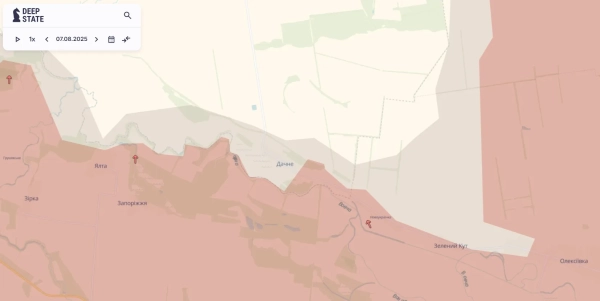
Dachny District August 7, 2025 / DeepStateMAP Map
As of the end of January 2026, the Russians occupied 9 villages in the Dnipropetrovsk region, and another 13 settlements were partially occupied or were in the gray zone. Russian troops entered the territory of the region to a depth of 21 kilometers, and the gray zone reached a distance of 26 kilometers from the administrative border with Donetsk Oblast.
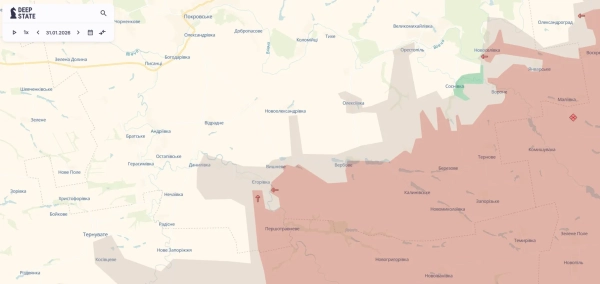
Front line on the border of Dnipropetrovsk, Zaporizhia and Donetsk regions as of the end of January 2026 / DeepStateMAP map
However, in mid-February, the Defense Forces began to conduct counterattacks, as a result of which they almost managed to clear the Dnipropetrovsk region of Russians. Western media began to call this operation perhaps the most successful since the counteroffensive in 2023, which failed, and the Kursk operation in August 2024. What happened there? We will tell you further.
Did the Russians' Starlink shutdown affect the success of the operation?
Information about the counterattacks of the Defense Forces in the Dnipropetrovsk region coincided with the painful shutdown of Starlink terminals for the Russians. In order to solve the problem of the use of this system by the Russians, so-called “white lists” appeared, which included registered terminals. Those that were not registered were simply disconnected.
And this became a real problem for the Russians, so many people associated the offensive operation with the shutdowns of the terminals. However, as the commander of the 1st separate assault regiment Dmitry “Perun” Filatov clarified in a comment to Channel 24 , the Defense Forces began attacking the Russians even before the Starlink shutdown.
According to the commander, if the terminals had been disconnected earlier, the operation would have been more successful.
Unfortunately, Starlink was turned off later, when we had already started the advance. If it had happened two days earlier, we would have gone 25 kilometers deeper than 12,
– says “Perun”.

Dmitry “Perun” Filatov / Photo of the 1st OSH
First of all, the success of the operation was ensured by several factors. The first of them was the element of surprise. The Oleksandrivka direction was quite unexpected for a counterattack, given that there were two really difficult and priority areas for both sides nearby – Gulyaipole and Pokrovsk.
In addition, an offensive group was quickly formed for the operation. As “Perun” noted, the Defense Forces command managed to form it in such a way that no other direction was weakened.
In addition to the units that were already in the Oleksandrivka direction, some units of the 8th Corps of the Airborne Assault Forces were moved there, including the 95th Brigade of the Airborne Forces. Oleksandr Kushnir, commander of the self-propelled artillery division, emphasized in a comment to Channel 24 that the attack by the Defense Forces was an unpleasant surprise for the enemy.
They didn't expect us there. The work was planned and implemented very well. However, we should not forget that the enemy is strong, he is regrouping and maneuvering, trying to conduct his counterattacks. However, we are also doing our job, as we should,
– says the officer.
Did the Russians have a defense line in the Dnipropetrovsk region?
The active phase of the offensive operation in the Dnipropetrovsk region has ended as of the second half of March. There is no “blue territory” on the DeepState maps, that is, one that would mean complete clearing and liberation. All settlements that were recaptured are now in the gray zone. As the analysts themselves explain, the reason is that there are still isolated enemy sightings in these villages.
Clearing the territory takes time. As Mikhail “Deputat” Trach, commander of the Sapsana battalion of the 30th Prince Konstantin Ostrozky Separate Rifle Brigade, explained in an interview with Channel 24 , the enemy uses the “thousand cuts” tactic – that is, maximum infiltration of small infantry groups in a certain territory. Although the enemy is in this territory, he does not have full control over it – the Russians are hiding in basements and pits.
The fact that the enemy did not have full control over the territory contributed to the Ukrainian counterattack, because the Russians did not have time to build defenses in the Dnipropetrovsk region. However, as the battalion commander notes, after this operation the enemy may take this experience into account and slightly change its tactics.
The situation in the Dnipropetrovsk region was to some extent due to the fact that the enemy found some kind of loophole. They ran there like cockroaches. However, in fact, the enemy did not have complete control over the territory. Because if that were the case, a defense system would have been built there and it would have been difficult to knock them out from there. The enemy entrenched himself there, occupied some basements and tried to advance further. At the same time, our Armed Forces were able to clear this territory and push the enemy back to the positions where he was, or even further,
– explained Mykhailo Trach.
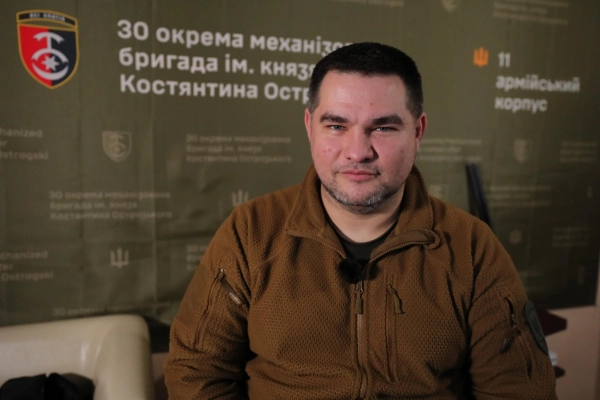
Mykhailo “Deputat” Trach / Photo of the 30th Motorized Rifle Brigade
Ivan Sekach, a spokesman for the 110th separate mechanized brigade named after Mark Bezruchko, also noted in a comment to Channel 24 that the main tactic of the Russians in the Oleksandrivka direction was in the form of “flag-raising.” That is, the Russians went to a certain settlement in small groups and hung their flag there. Thus, their propaganda shouted about the capture of the village.
The main task of the Russians was to demonstrate their advance and to make “flag-raising moves”. As a result, there were no places where they could gain a foothold, because there were no prepared defense lines. Therefore, it happened that in some villages there were not even Russians, although they had been captured earlier, or at most 1-2 Russians were sitting there,
– explains Sekach.
Although, apparently, after the start of active operations by Ukrainian troops, the Russians did begin preparing defenses in the area of the border of the three regions. However, the 110th Brigade notes that if Ukraine had sufficient resources, a similar operation would be possible in virtually any direction of the front.
If we had enough personnel for assault units, it would be the same anywhere. That is, the Russians used such tactics almost throughout the entire front. This is far from the Zaporizhzhia direction, when there was a real counteroffensive (in 2023, – 24 Channel) and when several echelons of defense were prepared by the enemy,
– says Sekach.
What is the situation in the Dnipropetrovsk region now?
As of the end of March, the villages of Maliivka and Zaporizhske in the Dnipropetrovsk region remain occupied. All others are either in the gray zone or still partially occupied. However, it is worth understanding that DeepState sometimes updates maps with a delay. Of the latest updates, so far, the advance of the Defense Forces in the area of the village of Berezove.
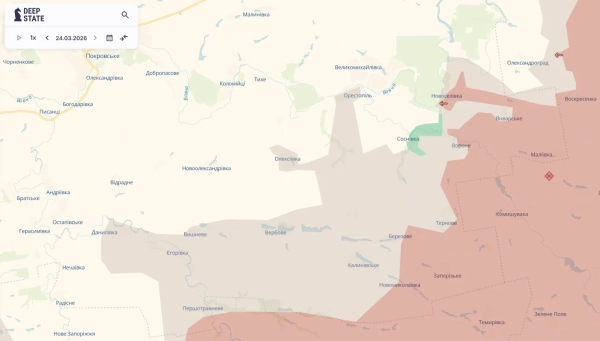
Oleksandrivskyi direction as of the end of March / DeepStateMAP
At the same time, Russian troops increased pressure on another section – in the area of the villages of Oleksandrograd and Iskra in the Donetsk region and advanced there towards the administrative border with Dnipropetrovsk region.
In general, we can state that the phase of active advancement has ended. Of course, this does not exclude further advances by our troops, but not on the same scale as in February.
It is obvious that after almost two months since the start of the counterattacks, the Russians are pulling up reserves to this area to prevent further advance of Ukrainian troops. However, the question then arises – where does the enemy get the reserves from, if the adjacent directions from Dnipropetrovsk region – Pokrovsky and Hulyaipilsky, are now the main priorities of the Russians?
Did the counterattack affect Pokrovsk and Hulyaipole?
The phrase “between two fires” can literally describe the Oleksandrivka direction. At the time of the start of the Defense Forces' counterattack, virtually half of all combat clashes on the front occurred in the Pokrovsk and Hulyaipol areas.
Serhiy Lefter, a communications officer in the 7th Airborne Assault Corps, who is currently responsible for defense in the Pokrovsk area, told Channel 24 that the counterattack in the Dnipropetrovsk region had no impact on their area of responsibility. Moreover, the Russians continue to conduct offensive operations in the Pokrovsk direction.
The enemy continues to bring up fresh reserves in the areas of Grishinoye and Dobropillya, trying to compensate for the shortage of manpower on the front line. The enemy considers Pokrovsk as a nodal point for further accumulation of forces. Their goal is to gain a foothold on the eastern borders for further advancement towards Grishinoye. However, as of now, we are stopping these attempts,
– Lefter emphasizes.
In addition, the officer emphasized that Pokrovsk remains one of Russia's priorities, although the situation suggests that the resources that could have been intended for the final capture of Pokrovsk are being used by the enemy in another direction.
We can assume that hypothetically, the resources that the enemy planned to attract for the final push to Pokrovsk currently remain tied up in Zaporizhia. And the enemy was forced to choose between two ambitions, not having enough fist power for simultaneous success on both vectors,
– says Lefter.
As for Hulyaipol, at the tactical level, the situation in the Oleksandrivka direction also did not have a significant impact on this area. As the commander of the 1st OSH “Perun” explained, there is another Russian group in the Hulyaipol direction. Although in a global context, the counterattack in the Oleksandrivka direction hindered the enemy's plans for the Zaporizhia region.
How does information silence help success on the front?
Another success factor was the information silence. There was a minimum of information about the course of the operation, mostly attempts by experts and journalists to analyze the available information and build assumptions on it. Comments from the military were limited and extremely poor in details.
It is worth recalling that the counteroffensive in 2023 had several reasons for its failure. And one of the most important, perhaps, is that the enemy was fully prepared for it. The direction of the offensive and the offensive itself were no secret, but when it came to direct attacks, it turned out that the Russians were waiting . Although, as the fighters who were the first to break through, in particular from the 47th Magura Motorized Rifle Brigade, later recalled, when the attacks failed, there were thoughts that they were actually a diversionary maneuver. The soldiers hoped that the main blow would actually be struck where the enemy really did not expect it. However, no miracle happened.
Therefore, in August 2024, the breakthrough of the Defense Forces into the Kursk region took place under complete information cover. Foreign partners did not know about Ukraine's intentions, which is why the Western press did not publish “insights”. When our troops already controlled Suja, foreign journalists called both the General Staff and the Office of the President, but there was only silence in response. Only on the 6th day of the operation did President Volodymyr Zelensky confirm that our troops were operating on Russian territory.
In 2026 , the operation in the Dnipropetrovsk region also began in conditions of information silence. The media had a minimum of information about what was happening in the direction. For a long time, the only thing that was known was that something was happening and, apparently, it was good for us. That's all.
However, not only civilians, but also the military themselves had limited information . According to Channel 24 sources in the Defense Forces, lower-level commanders and even battalion commanders did not have complete information about the plans and current situation in the entire direction.
This information is also confirmed by the commander of the 1st separate assault regiment named after Dmitry Kotsiubayl, Dmitry “Perun” Filatov. He emphasized that this is how operations should be conducted, because the fewer people know about the plans, the lower the risks of information leakage.
We have now come to the conclusion that 80% of the success of any operation is maintaining an information vacuum and secrecy. Not everyone here realizes that we need to talk less. Therefore, it should be so,
– emphasizes “Perun”.
How do Russians use information silence and claim victories?
It is no news to anyone that the Russians attribute fictional successes to themselves. We saw this clearly when the Russians were driven out of Kupyansk, but the propaganda claimed the capture of not only the city, but also the village of Kupyansk-Vuzlovy. Then all these attempts to paint successes collapsed when President Zelensky published a video that he personally recorded on the outskirts of Kupyansk.
However, the situation with the Dnipropetrovsk region was somewhat different – while there was information silence on the Ukrainian side, the enemy decided to paint successes for itself. One of the most interesting cases is the village of Rizdvyanka in the Zaporizhia region.
One of the main goals of the Russians in the Oleksandrivka direction was the village of Ternuvaty in Zaporizhia Oblast, which is also located on the border with Dnipropetrovsk Oblast. At the end of January, the Russians even tried to carry out a massive assault under the cover of fog, but it failed.
And now, on the anniversary of the invasion on February 24, after several weeks of active operations, the Russians of the Defense Forces in the Oleksandrivka direction claim that they have allegedly captured the village of Rizdvyanka in Zaporizhia region, southwest of Ternuva. Also, during the counterattacks in the Oleksandrivka direction, the enemy announced the occupation of several villages near Hulyaipol and Biliaivka in the Dnipropetrovsk region in the Pokrovsky direction. All of these settlements are located several kilometers from the gray zone, so what can we say about the direct line of contact?
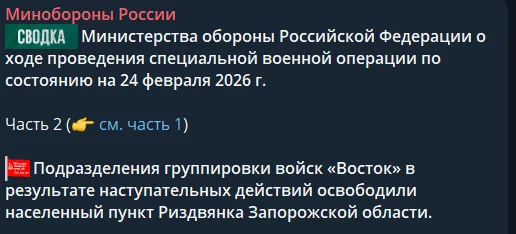
Russian Ministry of Defense announces alleged capture of Rozhdvyanka / Screenshot
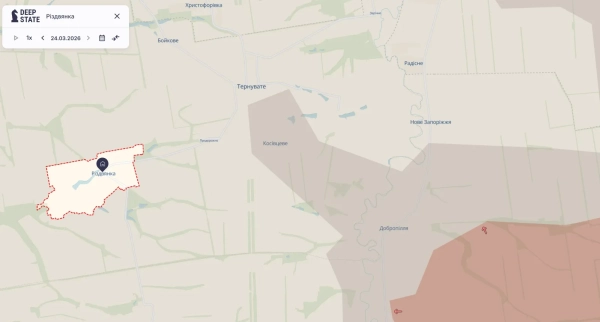
However, even from the gray zone, the village was still several kilometers away / DeepStateMAP map
Oleksandr Kushnir, commander of the self-propelled artillery division of the 95th Brigade of the Ukrainian Armed Forces, is certain that the statements of Russian propaganda have an exclusively political motive.
There is a purely political goal here. And, for example, it was like this in Kupyansk, when (the Russians, – 24 Channel) received medals and orders for capturing the city and thought that maybe later they would be able to advance. But it didn't work out,
– says Kushnir.
Although in recent weeks the Russians have not announced any progress in the Aleksandrovka direction, instead the Russian Ministry of Defense has been “feeding” the audience with content with allegedly successful defeats of Defense Forces positions.
Was it possible to thwart the attack on Zaporizhia?
Let's return to Ternuvaty. Earlier, in an interview with Channel 24, the commander of the 3rd mechanized battalion of the 110th Mark Bezruchko Motorized Rifle Brigade explained that this village is a dominant height and its capture was necessary for the Russians to continue their offensive towards the Donetsk-Zaporizhzhya highway. From there, directly to the latter.
The Defense Forces' counterattack, in particular, thwarted Russian plans to capture Ternuvaty and reach the Zaporizhzhia highway. In the near term, the Russian offensive on Zaporizhzhia has been thwarted, or rather postponed for now, because the Russians will clearly not give up trying.
The commander of the 1st Special Forces Division, Dmytro “Perun” Filatov, emphasizes that if the enemy had not attracted reserves to repel the attacks of the Defense Forces, it is quite likely that they would have been used to approach Zaporizhia.
The important thing is that we force the enemy to use their reserves not to increase the offensive, but to repel our offensive actions. If we had not done this here, they would have launched an offensive on Zaporizhzhia, would have increased the pressure from the Hulyaipil direction, would have tried to surround Orikhiv and go to operational depth to put pressure on Zaporizhzhia itself,
– says “Perun”.
Although the threats to Zaporizhia do not completely disappear. And it is not that the Russians can capture the regional center, but that they seek to get so close to it that they can devastate it with constant shelling.
The Russians are still trying to implement the “Gulyai-Pil” scenario for Orekhov – to approach from the east and at the same time take fire control of all routes from the north. However, the Russian plans for Zaporizhia region were significantly spoiled by the counterattack in the Oleksandrivka direction.
Counterattack or counterattack – what happened in the Oleksandrivka direction?
In February, the Defense Forces' operation was hastily called a counteroffensive, which in fact it is not. This, as the military themselves explain, is a counterattack. “Perun” from the 1st OSHB calls such attacks a necessity.
We are not forced to, we need to conduct offensive operations in those areas of the front where it is not advantageous for the enemy. It's like in boxing – you can defend well, but they don't give you points for defense. It's impossible to win if you just keep fighting back,
– the commander emphasizes.
However, the operation of the Defense Forces will obviously have consequences for the front. First of all, the enemy has to adjust plans for its spring campaign, which is already failing – enemy troops have been pushed back from the Zaporizhzhia highway, advances in the areas of Hulyaipol, Kostyantynivka and Pokrovsk are being made with enormous blood, and the assault in the Lyman area, which was prepared for a month and a half, has failed. Although, of course, this does not mean that the campaign is over and that the enemy is completely weakened.
Mykhailo “Deputat” Trach, commander of the Sapsany battalion of the 30th Motorized Rifle Brigade, is certain that after the events in the Oleksandrivka direction, the Russians will adjust their tactics, since infiltration and “thousands of cuts” are used almost on the entire front.
After that, the enemy must adjust its further actions. That is, certain reserves were involved in the Dnipropetrovsk region, there were hopes of creating additional pressure. However, this did not work. Adjustments will have to be made not only in the area of the border of three regions (Donetsk, Zaporizhia and Dnipropetrovsk, – 24 Channel), but also in the army as a whole,
– says the “Deputy”.
Almost everyone we spoke to in preparation for this material emphasizes the planning of the operation, as it was successful despite having to move some units and do it in a way that would not weaken other areas, and so that it would be a surprise for the Russians.
The defense forces were able to carry out a successful local counterattack in a direction unexpected by the enemy. This is a good sign for us, but we cannot underestimate the enemy.
Important. And no operation will be possible if the rear does not support the army. There are many ways to help the army, which is currently bearing the entire burden of this war. The easiest way is to donate to the collection. Now the 24 Channel website is collecting VW T5 vans for the 160th separate mechanized brigade. Follow the link and join.
You can find more collections for the needs of the Defense Forces on our website of the Charitable Foundation 24. There are also reports for already closed collections.