
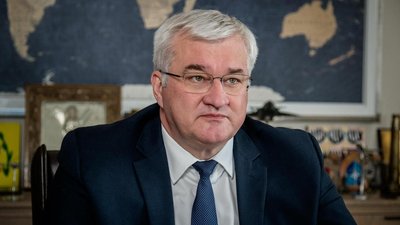
Ukrainian Foreign Minister Andriy Sybiga compared the actions of the Iranian authorities in the Strait of Hormuz with the actions of the Russian army in the Black Sea, stating that their tactics are similar. According to him, Kyiv is ready to contribute to unblocking the strait.
He said this during an international meeting on restoring freedom of navigation in the Strait of Hormuz, chaired by British Foreign Secretary Yvette Cooper, the press service of the Ukrainian Foreign Ministry reports.
Among other things, the minister pointed to a direct connection between the current situation in the Strait of Hormuz and the Russian Federation's war against Ukraine.
“Terrorist regimes exchange experience. What Iran is doing today in the Strait of Hormuz, Russia did yesterday in the Black Sea. The problem is that Iran has studied Russia's mistakes and drawn conclusions from them,” said the head of Ukrainian diplomacy.
Sibiga also noted that in the Strait of Hormuz issue, Tehran has the same goals that Moscow had in the Black Sea: to destabilize global markets and blackmail others.
In his opinion, the only difference is that four years ago Russia tried to “weaponize food, and today Iran is trying to weaponize energy.”
According to the minister, Kyiv is also directly interested in the stability of global markets, and, they say, “Russia cannot be allowed to use instability in the Middle East to finance many more years of war.”
Drawing parallels, Sibiga recalled that Ukraine managed to break through the Russian blockade in the Black Sea thanks to naval drones and a smart strategy.
“We succeeded because we acted decisively — and this is exactly the kind of thinking the world needs today. Ukraine's position is clear: terror must receive a decisive response, and freedom of navigation must be protected,” he emphasized.
The Foreign Minister added that the principles of the UN Convention on the Law of the Sea must be observed in the Strait of Hormuz, just like in the Black Sea.
“We must end this blockade. Ukraine is ready to work with the countries of the region on a bilateral level and cooperate with our transatlantic partners. Ukraine is ready to make its contribution,” Sibiga concluded.
On April 2, a summit of 35 countries was held under the British presidency to discuss ways to mitigate the crisis in the Strait of Hormuz, which is being blocked by the Iranian authorities against the backdrop of the US-Israeli military operation against Iran that began on February 28.
Why the Strait of Hormuz is so important to the global oil market
The Strait of Hormuz is one of the planet's most important energy hubs, through which about a fifth of all global supplies of oil and liquefied natural gas pass.
Any instability in this narrow sea route instantly affects global markets, as demonstrated by the events of March 2026. Currently, due to the threat of strikes from Iran, shipping has been effectively blocked, forcing some companies to limit traffic in this area.
On March 13, a Turkish oil tanker managed to pass through the strait with cargo despite an Iranian blockade. The very next day, March 14, US President Donald Trump called on European and Asian countries to send warships to protect trade routes and said that the US Navy would begin escorting commercial tankers “very soon.”
By March 20, an international coalition had been formed, including the United Kingdom, France, Germany, Italy, the Netherlands, Japan, and Canada. These countries formally condemned Iran's attacks on civilian infrastructure and expressed their readiness to guarantee safe passage for ships. The following day, March 21, the Iranian Navy escorted an Indian tanker through the strait.
On March 22, Tehran declared that the strait was open only to those not on the list of “enemies,” and Trump responded by threatening to destroy Iran's electricity grid if the blockade was not lifted within two days. On March 25, Iran solidified its position with a note to the UN Security Council, where it officially banned the passage of ships from the United States, Israel, and other “participants in the aggression,” allowing only “non-hostile” ships to pass through, subject to coordination with the Iranian authorities.
Despite these restrictions, the P. Aliki tanker carrying Saudi oil was able to pass through the strait along the Iranian coast on March 29. However, the overall shortage of resources became so acute that on March 31, Donald Trump addressed countries suffering from a shortage of jet fuel via the Truth Social network, effectively acknowledging the scale of the problem.
Global economic shock
The economic consequences of the month-long US-Israeli military operation against Iran have been negative for the global economy. The European Union has been forced to spend an additional €14 billion on fuel imports as gas prices have risen by around 70% and oil prices by 60%. European Energy Commissioner Dan Jorgensen has compared the situation to the “oil shock” of the 1970s, warning of the possibility of a major energy crisis.
Currently, governments of many countries, including the EU and Australia, are calling on citizens to adopt a strict austerity regime: work from home, use cars and planes less, and urgently switch to renewable energy sources. Australian Prime Minister Anthony Albanese noted that these effects will be felt for many months, making the issue of unblocking the Strait of Hormuz critical for the stability of the global market.