
Main points
- UNESCO experts predict a 100% probability of a tsunami at least one meter high in the Mediterranean Sea within the next 30 years.
- The French Cenalt warning system can detect a tsunami threat and transmit an alarm in less than 15 minutes, but for localized landslides, that time may not be enough.
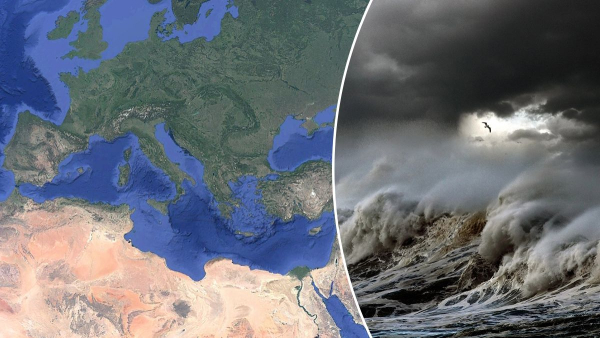
The Mediterranean Sea is not safe: scientists warn of an imminent tsunami / Collage 24 Channel/Depositphotos/Unsplash
The Mediterranean is often perceived as a safe place to relax, but experts are increasingly questioning this claim. Modern research and historical records indicate that the coast hides risks that can change the usual image of a peaceful resort region.
What is known about possible tsunamis in the Mediterranean Sea?
According to the conclusions of UNESCO experts, the probability of a tsunami of at least one meter in height in the Mediterranean Sea within the next 30 years is 100 percent. Although such phenomena are traditionally associated with the Pacific or Indian oceans, the Mediterranean basin ranks second in the world in terms of the number of cases recorded in history. On the French Riviera alone, about twenty incidents were recorded from the 16th century to the early 2000s, when the height of the waves exceeded two meters, writes SciTechDaily.
Tsunamis are different from ordinary wind waves in nature. They are caused by sudden shifts in the seabed caused by earthquakes, underwater landslides, or volcanic activity. In deep water, such a wave may remain invisible, but as it approaches land, it compresses and rises upward, turning into a powerful current.
The real danger lies not only in the height, but in the speed and colossal force: water rushing onto land creates a pressure of several tons per square meter, which is enough to destroy buildings, roads, and port infrastructure.
Historical examples confirm the seriousness of these concerns:
- In February 1887, after an earthquake in the Ligurian Sea, the water first receded from the coasts of Antibes and Cannes by about one meter, and then returned in a wave almost two meters high, covering the beaches.
- In October 1979, an underwater landslide during the construction of the port in Nice caused a tsunami that killed eight people and caused significant destruction in nearby cities.
- Even distant events have consequences: the 2003 Algerian earthquake caused severe whirlpools and damage to boats in French marinas just 75 minutes after the tremors.
The time for rescue in the Mediterranean is critically limited. If the source of a tsunami is located close to the shore, such as in the Ligurian Sea between Corsica and Italy, the first wave can reach the coast in less than ten minutes.
In the case of more remote events off the coast of North Africa, this time increases to 90 minutes. The French Cenalt warning system, operational since 2012, is able to detect a potential threat and transmit an alarm in less than 15 minutes, in particular via the FR-Alert platform to the mobile phones of people in the danger zone.
However, for local landslides, this time may not be enough, so it is important for residents to be aware of natural signs of approaching disaster: noticeable earthquakes or an unexpected retreat of the sea.
Who is at risk?
- The risk zone on the Mediterranean coast of France covers 187 cities and about 1,700 kilometers of coastline, writes The Conversation.
- According to experts, more than 164,000 permanent residents are at risk, and during the peak summer season, the number of people on the beaches can reach 835,000.
- Nice is particularly vulnerable due to its dense development and huge influx of tourists.
To protect the population, Nice has developed a detailed evacuation strategy based on scientific models. It takes into account optimal walking routes, the presence of obstacles and possible crowds. Around a hundred safe shelters have been identified, located outside the reach of the waves.
Educational programs and training in schools are also being implemented to create a culture of safety. Such initiatives are part of the international UNESCO program “Tsunami Ready”, which Cannes has already joined, and Nice is preparing to receive this status in the near future.