
Main points
- Meta has suffered losses of over $70 billion since 2021 due to failures in the development of the metaverse, which led to a 30% reduction in Reality Labs funding.
- The main problems with the metaverse are the lack of a “killer app”, technical and biological limitations, and the mismatch between high expectations and reality, although artificial intelligence may revive interest in the future.
From hype to disappointment: the real state of metaverse development in 2026 / Collage 24 Channel/Depositphotos/Meta
Just a few years ago, the concept of digital worlds seemed like an inevitable future that would transform the way we communicate and work. But today, Meta’s ambitious project faces serious challenges, forcing investors and users to question the feasibility of such a colossal expense and effort.
Has the metaverse become another technological bubble that burst under the pressure of reality?
The idea of immersion in virtual spaces, which once caused a stir, has now significantly lost its appeal to a wide audience. Meta Corporation, which even changed its name for the sake of this concept, faced staggering financial indicators at the end of 2025: losses have exceeded $70 billion since 2021. This forced management to prepare a 30 percent reduction in funding for its Reality Labs division, writes 24 Kanal .
The situation looks so unstable that Meta, which has become a symbol of the bet on the metaverse, initially announced the closure of the Horizon Worlds platform in June 2026, although it later changed its decision, leaving access for owners of Quest headsets.
Analysts say the metaverse brand is now seriously damaged by excessive expectations that have not matched reality. Experts believe that the vision of a world where everyone works and plays as cartoonish avatars was a marketing exaggeration.
The main problem, as Live Science writes, was the lack of a so-called “killer app” – a unique feature that would convince ordinary people to use the new technology instead of familiar tools such as Zoom or Slack.
The problem is with the person, not the technology.
Most experts agree on one thing: the metaverse failed not because of bad ideas, but because of a poor understanding of human behavior.
Assistant Professor of Augmented and Virtual Reality at the Hong Kong Polytechnic University, Lik-Han Lee, author of a study on the metaverse published in the journal Computers and Society, notes that the grand vision of a single shared virtual universe has always been more science fiction than a realistic plan.
According to him, VR meetings and virtual offices turned out to be just a more inconvenient version of Zoom or Slack – without any convincing argument why you should choose them.
All failed
However, Meta was far from the only one who believed in the metaverse. The idea that people would migrate en masse to virtual worlds for work, study, and recreation was not new. The first attempts to build digital worlds date back to the 1990s, and in science fiction, even to the 1960s.
In 2003, the Second Life platform appeared, which made a splash, but never became widespread due to technical limitations and copyright issues. Facebook returned the idea to public discourse in the early 2020s, using the COVID-19 pandemic and the mass transition to remote work as an argument.
Since Facebook was and remains one of the world’s leading companies, and its presentation was explosive, many other companies immediately announced their own similar efforts in the field of metaverses. Where are they now? It is unlikely that you have heard of even one, because in just two years, artificial intelligence has taken over all the attention.
But even as the hype was at its peak, polls recorded skepticism. A June 2022 Pew Research poll found that 46 percent of respondents didn't believe that the metaverse would truly become a full-fledged part of everyday life by 2040. No one simply saw themselves in the virtual world for work, partying, or shopping.
When technology meets biology
Technical and biological limitations have hindered widespread adoption. Current headsets remain bulky and uncomfortable, have a narrow field of view, poor graphics, and prolonged use often causes nausea and headaches due to the conflict between visual perception and muscular focusing of the eyes.
The latter is related to a phenomenon that was studied in a 2024 study in the Journal of Optometry. Scientists explain this by a disruption in the connection between vision, the vestibular apparatus and the nervous system, since the human body perceives the world not only with its eyes. It is a conflict between what the eyes see as space and how the brain tries to respond to it. Researcher Jennalyn Ponrai from the specialized Delaire laboratory explains that humans are not purely “visual” organisms. When VR overloads the vision but ignores the rest, the result is fatigue, nausea and cognitive load.
Thus, until the devices become as light as regular glasses and begin to engage other sensory systems of the body, this barrier is considered almost insurmountable.
Fictional problems
Additionally, it has been found that virtual spaces often attempt to solve problems that users do not have. For example, creating virtual showrooms for shopping often cannot compete with traditional social media browsing due to the complexity and time required to set up the equipment.
Real-life cases confirm this skepticism. One market operator says that a large retail brand spent half a year creating a virtual showroom where buyers could view products in the form of avatars. In the first month after launch, attendance dropped to zero – buyers simply returned to their usual Instagram.
Former Facebook, Unity, and Adobe engineer Mircea Dima believes that even if headsets become lighter and more comfortable, this will not solve the main problem: no one will wear a device on their face for tasks that are faster performed on a laptop or smartphone.
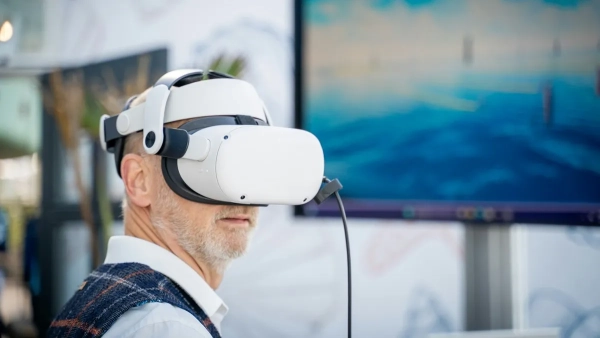
No one wants to wear a bulky headset for something they can quickly do on a computer or smartphone / Photo by Paul Einerhand
Investors don't want to admit the truth
Mircea Dima also draws attention to the phenomenon of the “sunk cost fallacy” – the unwillingness to admit wasted investments. This, in his opinion, explains why the metaverse still has its supporters despite its obvious failures. They simply pretend and continue to pretend that everything is fine, in order not to accept the painful truth: billions of dollars will never be returned.
Does the metaverse have a future?
Despite the current decline, some experts see this not as the death of the idea, but rather as its transition into a mature phase. The basis for a future revival may be artificial intelligence, which will allow the automation of the creation of complex content and 3D environments, which was previously too expensive and laborious a process. Perhaps the metaverse is simply in a phase of accumulating technological potential, similar to that experienced by other devices that were ahead of their time.
Futurist Mark van Riemenam, who publicly analyzes future technologies, says that the real process of development is taking place despite the apparent decline of hype – it has simply become less noticeable. In his opinion, what seems like a retreat is actually a rethinking: the technology is being built anew, but with practical application, not for the sake of PR.
Joachim van der Meulen, who has been developing VR content since 2017, says AI-powered tools have helped overcome long-standing technical challenges and opened up possibilities for generating 3D environments. Lee adds that AI could provide what the first generation of metaverses lacked: the ability to automatically create content, generate realistic characters, and personalize experiences in real time.
The parallels with other technologies are also telling. The Apple Newton and Google Glass were once considered failures – now it’s clear that they simply came before the world was ready. Smart glasses like the Ray-Ban Meta are already bringing some of the ideas of augmented reality back to the consumer market, though they face regulatory and privacy challenges.