
Main points
- The Kikai supervolcano, which has been dormant for 7,300 years, is once again filling with magma, causing concern among scientists.
- The study revealed the existence of a new magma reservoir beneath the volcano, which could lead to a potential eruption.
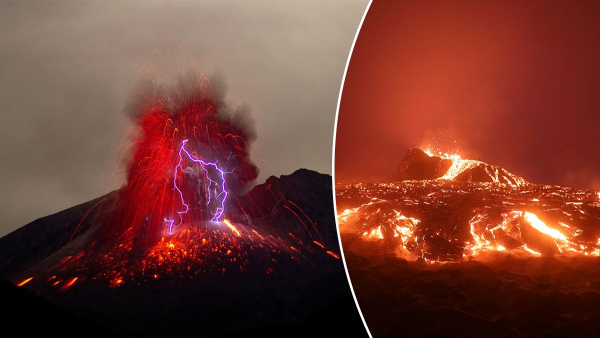
The largest volcano of the Holocene began to accumulate strength again / Collage of Channel 24/Unsplash
Researchers from Kobe University have detected dangerous activity beneath the ocean's surface. An ancient supervolcano that caused the most powerful eruption in the history of the current geological era has begun to fill with hot material again, causing serious concern among the scientific community.
Why are scientists worried?
Some volcanic systems are so destructive that if all their magma were collected in a basin with an area of 3-4 square kilometers, it would fill to a height of about 12 kilometers. After such large-scale events, only a huge and relatively shallow depression called a caldera remains in place of the mountain. Such objects include the underwater Kikai caldera, located off the coast of Japan, the last catastrophe of which occurred about 7,300 years ago, writes Phys.org.
It was the largest eruption in the current geological period, the Holocene. Although science knows that such systems are capable of repeated eruptions, the mechanisms of preparation for them still remain a mystery, making prediction almost impossible.
To address this problem, geophysicist Seama Nobukazu of Kobe University, together with colleagues from the Japan Agency for Marine-Earth Science and Technology (JAMSTEC), conducted a large-scale study. The underwater location of the object paradoxically turned out to be an advantage, as it allowed for systematic scanning over large areas.
Scientists used arrays of air guns to create artificial seismic pulses, and special bottom seismometers recorded how these waves passed through the Earth's crust. This technology helped to study in detail the state of the subsoil under the volcano.
The results of the work, published on March 27 in the scientific journal Communications Earth & Environment, confirmed the existence of a huge reservoir filled with magma directly beneath the site of the ancient eruption.
The researchers were able to determine its exact size and shape. Analysis showed that in its location and scale it is the same magma basin that fed the volcano millennia ago. However, further study brought an unexpected discovery: the substance inside the reservoir is not the remains of a past explosion.
Everything starts again
Over the past 3,900 years, a new lava dome has gradually formed in the center of the caldera. Chemical analysis of materials from this dome and other recent activity has shown that their composition is significantly different from that erupted 7,300 years ago.
This suggests that completely new magma, recently intruded into the system, is now accumulating beneath the dome. Based on this data, a general model has been proposed for how energy reserves in giant calderas are restored.
The proposed model of magma refilling is consistent with data on the state of other known supervolcanoes, such as Yellowstone in the United States of America or Toba in Indonesia.
What does this give us?
Understanding magma supply cycles after catastrophic events is critical for planetary safety. Seama Nobukazu says the team's main goal is to improve observational methods to accurately identify key indicators of future giant eruptions.
Further research will help to better understand the processes of injection of new molten rock into the crust and prepare for possible challenges from giants hidden underwater.
What is the difference between a regular volcano and a supervolcano?
The main difference between a regular volcano and a supervolcano is the scale of their eruptions and their consequences for the planet. A supervolcano is not simply a “bigger version” of a volcano, but rather a regional volcanic system with the potential for catastrophic events.
- Ordinary volcanoes form conical mountains or shields with a distinct vent through which lava erupts.
- Supervolcanoes do not have a visible summit – after a mega-eruption, a caldera (a huge depression) is formed as the roof of the magma chamber collapses.
Calderas of supervolcanoes, such as Yellowstone (USA) or Toba (Indonesia), reach tens of kilometers in diameter, and their activity is manifested through geysers, fumaroles and earthquakes. A supervolcano eruption can last from days to decades, with pyroclastic flows hundreds of meters thick covering thousands of square kilometers.
Ordinary eruptions threaten local regions – with tsunamis, lava flows or ash fallout for hundreds of kilometers around. Supervolcanoes cause global climate change: ash in the stratosphere blocks the sun across the planet, causing a “volcanic winter” for years, as after Toba 74 thousand years ago – the largest eruption in 28 million years.
Only 12 such events have occurred in the past 17 million years, at a frequency of once every 50,000 years, making them rarer than large asteroid impacts. The consequences include mass extinctions, famine, and a cooling of the planet by 5 to 10 degrees.
There are about 20 supervolcanoes on the planet, including Yellowstone, Camp Flegrei (Italy) and Taupo (New Zealand). There are many more ordinary volcanoes. According to various estimates, at least 1,500 active terrestrial volcanoes can be found throughout the planet. From 50 to 70 of them erupt every year. At the same time, about 20 objects around the world are usually in a state of eruption.
There are many more underwater volcanoes – scientists estimate that there may be over a million volcanic structures on the ocean floor. Most of them are small, but they are responsible for 75% of the annual volume of magma that reaches the surface.